

Introduction
Introduction
You did not build an audience just to collect followers. You did it because you believed it could become something — income, freedom, a business you actually own. But the views keep coming and the business never quite shows up.
Here is the truth nobody says plainly: an audience is not a business. It is the raw material for one. And the gap between the two is not more followers — it is a system.
This guide covers how to read your audience's signals, turn trust into a clear next step, pick one revenue path, and run a feedback loop — so attention finally has somewhere to go.
An Audience Is Not a Business (Yet)
An audience is attention you rent. A business is value you own. You can have 50,000 followers and no revenue path, or 800 email subscribers who trust you and buy what you recommend. The second one is closer to a business — even though it looks smaller on paper.
For your own business, investigate the problem and purchasing behavior of a specific audience instead of treating a market-size forecast as evidence of demand. Customer interviews, alternatives, and a small offer test can help you decide where to invest.
The market rewards clarity and trust, not just size. The rule: you do not need a bigger audience. You need a clearer path.
Look for Repeated Audience Signals
Most creators guess what their audience wants. Your audience is already telling you what they will pay for — in the same question asked five different ways, the comment you have answered ten times, the DM that ends with the exact problem you could solve.
One request is noise. A pattern across 20 conversations is a signal. The problem your audience repeats is not small talk — it is your product brief.
Read your last 30 comments and DMs. Write down every question.
Group them. Which problem shows up most often?
Note the exact words people use — their language becomes your marketing copy.
Turn Trust Into a Clear Next Step
Here is where most creators leak: the content gets attention, and then nothing happens. Trust without a next step is a dead end. Every piece of content should point somewhere — and the smartest place to point it is a channel you own.
An owned channel is an email list, community, or subscriber base where you can reach people directly, without an algorithm deciding who sees you. Unlike followers on a platform, an owned channel travels with you if the platform changes the rules overnight.
You do not need a fancy funnel. You need one bridge: a simple free resource — a checklist, template, or short guide — that solves one slice of the problem and asks for an email in return. That is the start of a business.
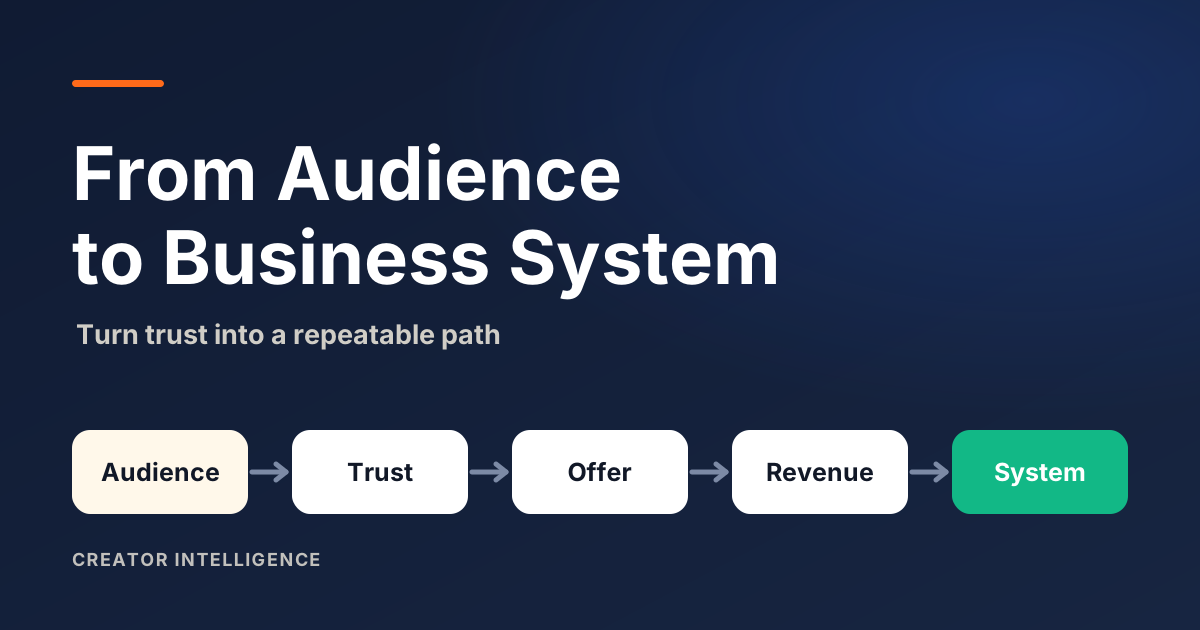
Not sure which part of your path is broken — audience, trust, offer, or system? The Creator System Readiness Quiz finds your biggest gap before you build anything new.
Pick One Simple Revenue Path First
You do not need five revenue streams. You need one that works. At small and mid-size audiences, the models that convert fastest are the ones built on trust, not reach.
Model the path with the Creator Revenue Calculator before you commit weeks of work, and if you are staring at a blank page, the Creator Prompt Generator turns your audience's pain points into specific offer ideas. The rule: test the smallest useful offer before you build the big one.
Coaching or consulting — highest revenue per sale, no product to build, works even with a small audience.
A digital product — a template, toolkit, or short course that solves the repeated problem once.
A paid workshop — one focused session, sold live, validated in a week.
Affiliate or sponsorship — better with clear reach and a defined niche; disclose paid relationships clearly to protect trust.
Build a Feedback Loop
The first version of your offer is not the product. It is the research. Every sale teaches you something. Every no teaches you more.
The creators who win are not smarter — they run a loop: offer, listen, adjust, offer again. Cut what does not land. Double down on what does. Ask every early buyer one question: what made you buy? Their answer is your next headline.
Common Mistakes to Avoid
Building a following with no email capture — when the platform shifts, the audience is gone.
Launching the big product first — you skipped validation and bet weeks on a guess.
Selling everything at once — if you solve five problems, people remember none.
Waiting for 10,000 followers — small, engaged audiences convert better than large passive ones.
Hiding the offer — if you only ever give free content, people learn to expect only free.
Your 7-Day Audience-to-Business Plan
You do not need a quarter. You need a focused week.
Day 1–2: Find the signal — collect your most-repeated audience question.
Day 3: Shape one offer — write a one-sentence promise: I help [audience] do [result] without [pain].
Day 4: Build the bridge — create one simple free resource that earns an email.
Day 5: Model the math — use the Creator Revenue Calculator to check price and conversion at your size.
Day 6: Make the offer — tell your audience plainly, using their own words.
Day 7: Listen — talk to anyone who responds, note objections, and adjust.
What to expect: not overnight income, but a first signal — real interest, a first sale, or clear feedback — that tells you whether the path is real before you scale it.