

Introduction
Introduction
Let's be real. For years, “creator marketing” mostly meant one thing: a brand paid a creator to post something, once, and hoped it worked.
That era is ending.
Creator marketing is maturing into a real marketing discipline — one with systems, measurement, and long-term relationships behind it. And you do not have to take my word for it. The biggest players in the marketing world are now buying their way into it.
Here's the thing: when consulting giants start acquiring creator agencies, the message is clear. This is no longer a side experiment. It is becoming infrastructure.
From Influencer Posts to Creator Infrastructure
The old model was simple and shallow. Find a creator with a big audience. Pay for a post. Move on.
The new model is structural. It treats creator content as an asset and the creator relationship as a system.
Creator marketing — the practice of partnering with creators to reach, build trust with, and convert an audience — now spans far more than a single post. It includes always-on partnerships, content reused across paid ads, email, landing pages, and retail, performance-based pay, social commerce, and measurement that ties content to outcomes.
That is the difference between influence and infrastructure. Influence is a moment. Infrastructure is a system you can run again next month.
Why Enterprise Interest Matters
On June 8, 2026, Accenture announced it had agreed to acquire Whalar, a global creator and social agency, folding it into Accenture Song.
This is not a small signal. Whalar has managed more than $600 million in creator campaigns and worked across 40-plus countries and 15 languages. Whalar's co-founder called it the “largest creator economy transaction” to date. Financial terms were not disclosed, so treat the “largest” label as his framing, not an audited fact.
Why does a global consulting firm want a creator agency? Because creator marketing has become big enough — and measurable enough — to sit next to data, AI, and commerce. In Accenture's own words, the goal is to connect “real-time insights, social commerce and AI-driven discovery” so creators move “beyond isolated activations into integrated customer experiences.”
And the money backs it up. The IAB projects U.S. creator-economy ad spend will hit $43.9 billion in 2026 — one of the fastest-growing segments in all of media.
What Creators Should Learn From the Shift
Here's where most creators get this wrong. They see a headline like the Accenture–Whalar deal and think, “That has nothing to do with me. I'm not an enterprise.” Wrong lesson.
You do not need an agency or an enterprise contract. But you should pay attention to what the market is now paying for. The same things big buyers want are the things small brands and your own audience reward too.
Trust over reach: brands are investing in micro and nano creators because niche trust often converts better than a huge, loosely connected following.
Measurable outcomes: performance-based deals — a base fee plus commission — reward creators who can show results, not just impressions.
Reusable content: one piece that works across social, ads, email, and retail is worth far more than a one-time post.
Reliability: always-on partnerships favor creators who deliver on time, on brief, and on brand.
The market is moving from “How big is your audience?” to “How dependable is your system?”
The New Creator Marketing Stack
You do not need enterprise software to think like infrastructure. You need a few layers working together.
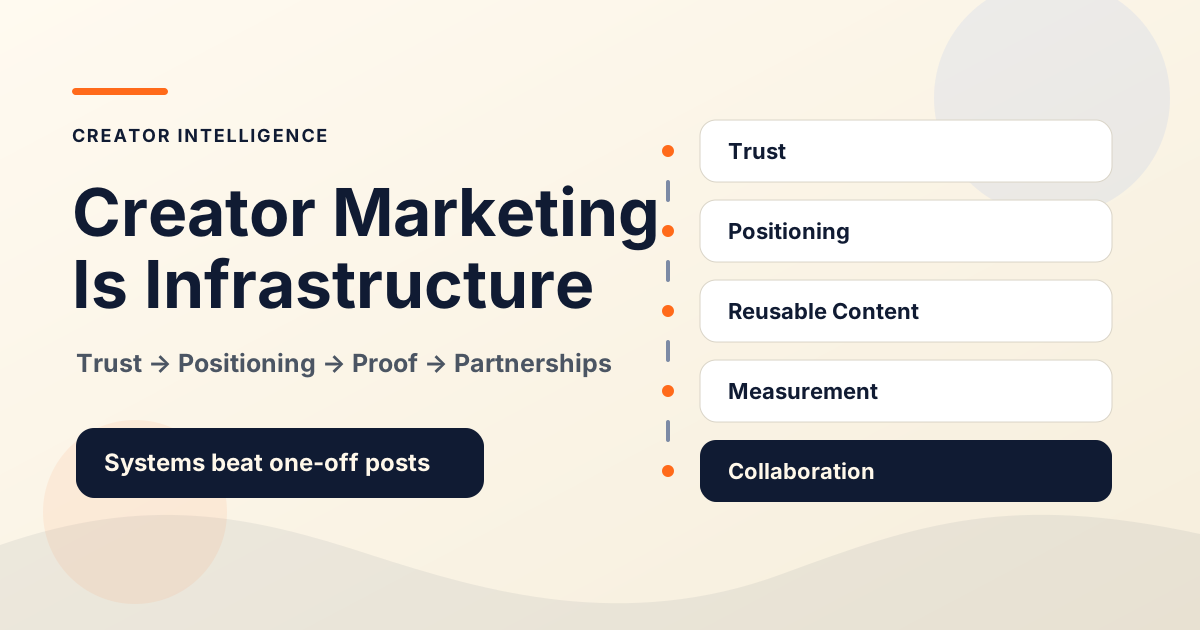
Think of your creator marketing stack as five connected parts.
Trust — a clear point of view and an audience that believes you.
Positioning — a specific niche and a reason brands choose you over someone with more followers.
Reusable content — assets built to work in more than one place.
Measurement — simple, honest numbers you can share: saves, clicks, replies, conversions where they apply.
Collaboration systems — clear rates, fast communication, briefs, timelines, and deliverables.
Most creators have the first layer and skip the rest. Trust without positioning, proof, and process is hard to partner with.
How Creators Can Become Easier to Partner With
Want the honest version? Most brand partnerships die not because the creator lacked talent, but because the creator was hard to work with.
Slow replies. No media kit. No clear rates. No way to measure results. Vague deliverables. You fix that with systems, not charisma.
Keep a simple, current media kit: who your audience is, what you make, and what results past content drove.
Set clear rates and packages so a brand does not have to guess.
Track a few real metrics so you can speak in outcomes, not vibes.
Use a repeatable process for briefs, drafts, approvals, and delivery.
Build content that can be reused — and tell partners that up front.
What Not to Do
Let me be honest with you about the traps.
Do not assume reach is enough. A big number with weak trust is a weak offer.
Do not chase every brand. Fit beats volume; the wrong partnership costs you audience trust.
Do not overpromise. Never guarantee sales, virality, or income — promise effort and process, not outcomes you cannot control.
Do not fake your numbers. Inflated metrics get discovered fast in a measurement-driven market.
Do not wait for an agency to find you. Build your system now, at any size.
Practical Creator Marketing Checklist
Use this to audit yourself this week.
Can you describe your audience in one clear sentence?
Do you have a current media kit a brand could read in two minutes?
Are your rates and packages defined?
Can you show three real outcomes from past content?
Is at least one piece of your content built to be reused?
Do you have a repeatable process for briefs and approvals?
Have you turned down a poor-fit partnership in the last six months?
If you answered “no” more than twice, you do not have a creator marketing problem. You have a systems problem. And systems are fixable.