

Introduction
Introduction
Most creators respond to a slowdown by producing more. More reels. More posts. More shorts. More emails. More hooks. More formats. More experiments.
Sometimes that helps. Consistency still matters. Buffer found that creators who posted at least weekly for 20 or more weeks in a 26-week period saw far higher engagement per post than creators who posted only a few times. Showing up repeatedly builds familiarity.
But familiarity is not the whole business. If your content does not point anywhere, more publishing just creates a larger pile of disconnected work. You can get views without subscribers, subscribers without an offer, and sales without knowing why they happened.
That is the difference between content and a system.
A Creator System Is Not a Calendar
A content calendar tells you what to publish and when.
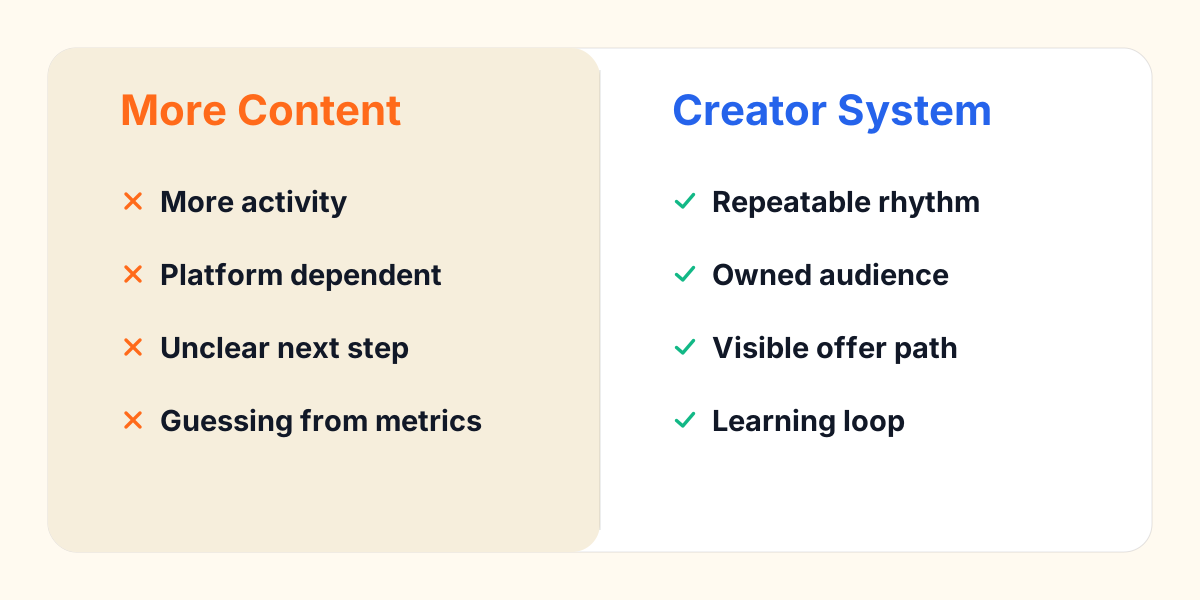
A creator system tells you why the content exists, who it is for, what action it should support, what offer it connects to, and how you will learn from the result.
The calendar is one small part of the production layer. The system is the whole operating loop.
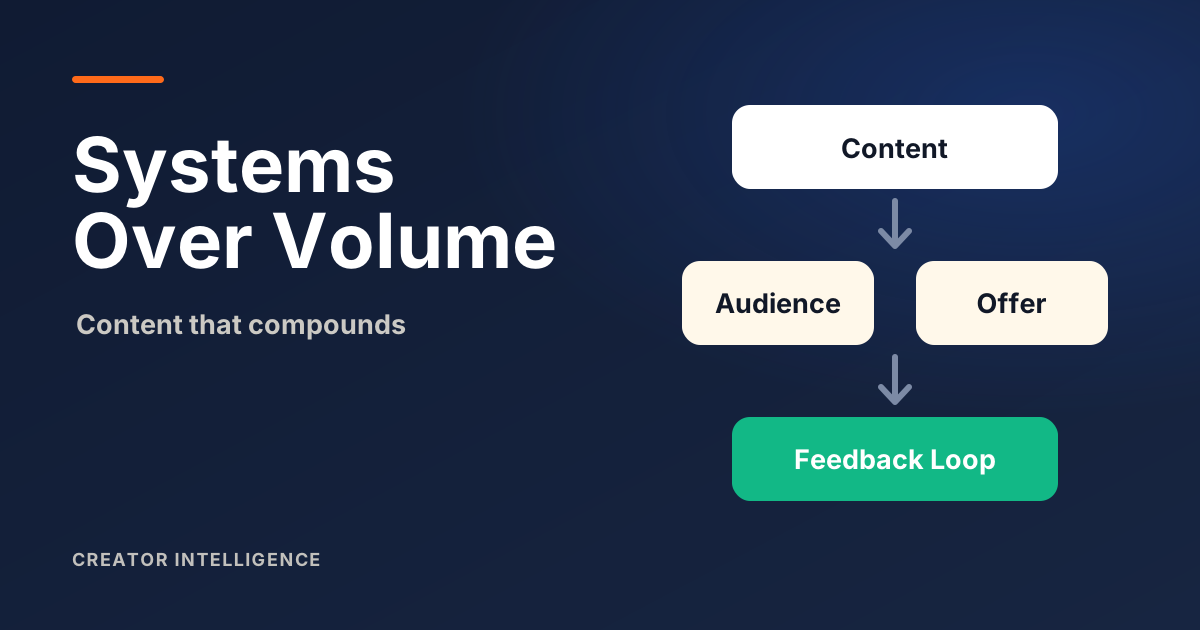
A creator system is a repeatable workflow that turns attention into trust, trust into owned audience, owned audience into offers, and feedback into better decisions.
Kajabi's 2025 creator commerce research points in this direction. The report describes creators moving beyond social-first income and toward owned products, communities, newsletters, courses, coaching, and memberships. The important shift is control: creators are trying to own more of the relationship and more of the income path.
The Five Layers of a Creator System
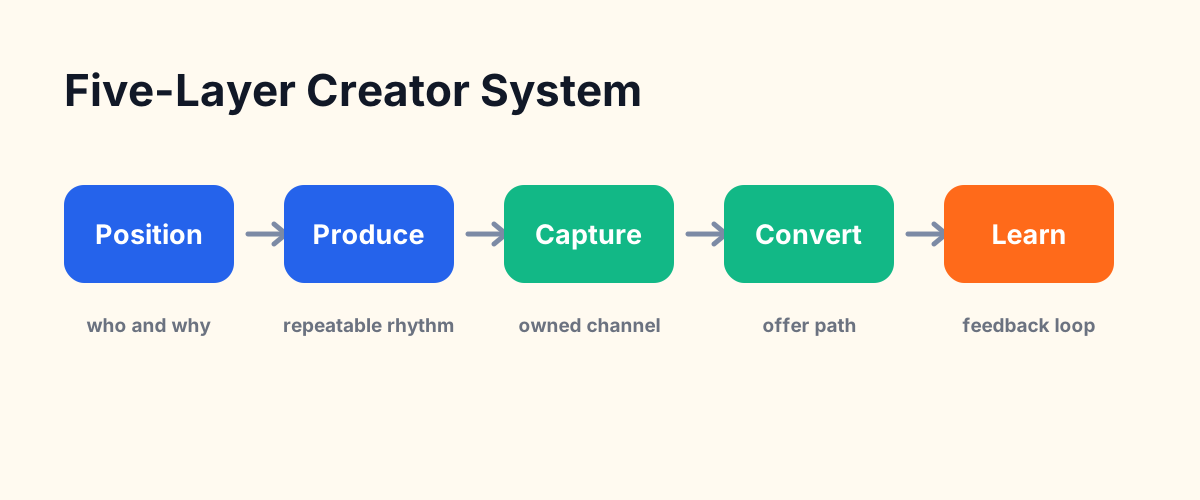
The simplest creator system has five layers: position, produce, capture, convert, and learn.
Positioning answers who you are helping, what problem you help them solve, and why they should trust your way of seeing it. Without positioning, content becomes generic. Generic content can still get attention, but it rarely compounds into loyalty because the audience does not know what to come back for.
Production covers formats, cadence, scripting, recording, editing, scheduling, and repurposing. This layer matters because a system has to survive normal weeks, not just inspired weeks.
Capture is where attention becomes an owned relationship through an email list, community, newsletter, private resource library, or subscriber database.
Conversion makes the next value exchange visible. That might be a workshop, consulting offer, paid newsletter, course, toolkit, membership, or service.
Learning is the feedback layer. This is where you stop asking only whether a post did well and start asking whether it attracted the right people, grew the owned channel, supported an offer, or taught you what the audience is trying to solve next.
Every Piece of Content Needs One Job
The easiest way to make your system useful is to assign every piece of content one primary job.
Most creators overuse attract and educate. Those are important, but they do not complete the system.
If none of your recent posts captured audience information, the system has a leak. If none of your posts mentioned the offer, the system has no conversion path. If none of your posts were reviewed afterward, the system cannot learn.
The five jobs content can perform inside a creator system.
| Content Job | What It Does | Example |
|---|---|---|
| Attract | Reaches new people. | Search-friendly post, short-form hook, shareable opinion. |
| Educate | Builds trust. | Tutorial, breakdown, example, mistake analysis. |
| Capture | Moves people to an owned channel. | Lead magnet, newsletter CTA, community prompt. |
| Convert | Points to a paid next step. | Workshop invite, product story, service case study. |
| Retain | Keeps loyal people engaged. | Member update, behind-the-scenes note, Q&A. |
More Content Can Hide a Broken System
Publishing more can feel productive because the work is visible. You can count the posts. You can see the calendar fill up. You can tell yourself you are moving.
But more output can also hide the real bottleneck.
The audience is not clear.
The content is helpful but not connected to an owned channel.
The offer is not visible.
The creator is optimizing for likes when the business needs email replies.
The format changes every two weeks instead of improving from a stable pattern.
This is why 'just post more' is incomplete advice. It skips the part where the creator decides what the content is supposed to do.
A Simple 10-Post Audit
Use this before building anything new.
Open your last 10 pieces of content and tag each one with one primary job: attract, educate, capture, convert, or retain.
Then answer four questions: which job appears most often, which job is missing, which post created the strongest audience signal, and what the next three posts should do differently.
You do not need a complicated dashboard to start. You need a clear operating question: where is the path breaking?
What Creator Intelligence Recommends
Creator Intelligence should treat content as an operating system, not a pile of assets.
For our Creator Intelligence workflow, the practical model is to research the audience problem, turn the problem into a useful article, brief, or tool, create one visual asset that clarifies the idea, add a capture path, connect the topic to a relevant offer or next step, and review performance for the next research cycle.
This keeps content useful for SEO, GEO, human readers, and AI answer surfaces without turning the brand into a content factory.
Research Notes Behind This Framework
The systems argument is supported by broader creator and content marketing research. Creator revenue is shifting toward owned products and audience relationships, while content teams continue to struggle when strategy is not tied to goals, journey alignment, lead capture, scalable production, and measurement.
Sources used for editorial context.
| Source | Why It Matters |
|---|---|
| Kajabi 2025 State of Creator Commerce | Frames creators as entrepreneurs building products, communities, newsletters, courses, coaching, and memberships. |
| IAB 2025 Creator Economy Ad Spend & Strategy Report | Shows creator work becoming a formal channel where measurement and operational tools matter. |
| Content Marketing Institute 2025 Benchmarks | Shows content strategy struggles when goals, journey alignment, scalable process, and measurement are weak. |
| Buffer social media data | Supports consistency as a repeatable rhythm, not a call for endless publishing. |
| HubSpot State of Marketing | Shows AI is now common in content workflows, raising the value of point of view and trust. |