

Introduction
Introduction
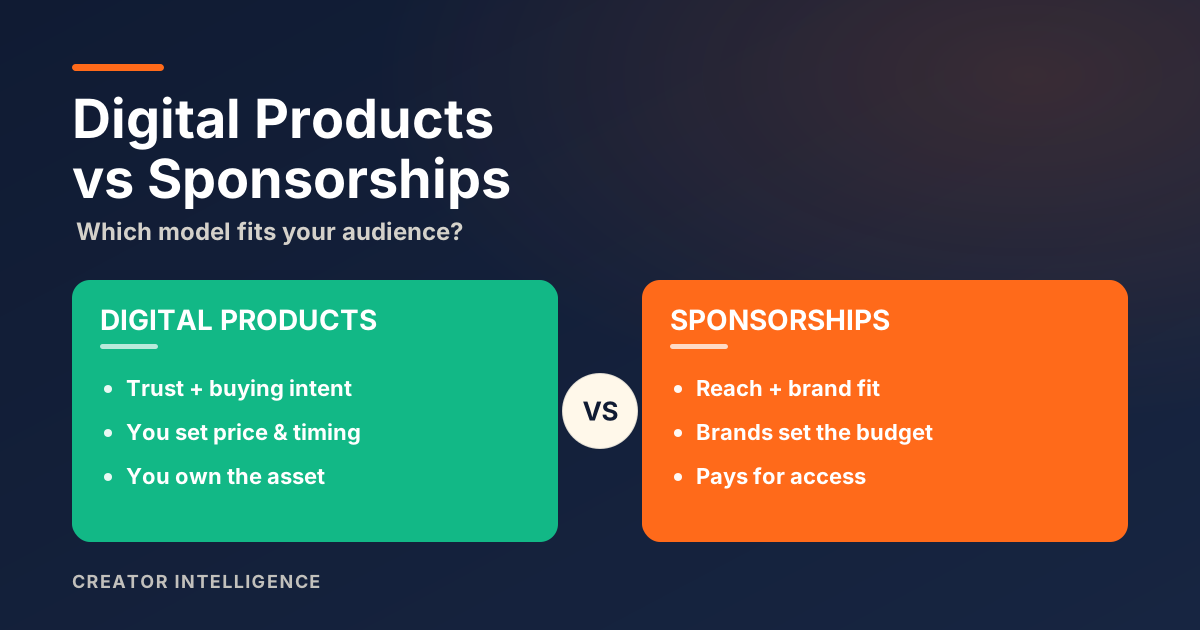
Most 'which makes more money' debates miss the point. Digital products and sponsorships are not two options for the same business. They are two different businesses — one built on what you own, the other on who you can reach.
Pick the wrong one for where you are right now, and you can spend months building revenue that was never going to show up. Pick the right one, and a small audience can pay you sooner than you think.
This article explains how each model works, compares them on the six factors that actually decide fit, and shows how to read your audience to choose the right starting point — then combine both.
How Digital Products Work
A digital product — a template, guide, course, workshop, or toolkit — earns money when your audience has a specific problem and trusts your process for solving it. The conversion event is a purchase, not a view.
Here is what most creators miss: digital product revenue scales with offer depth and audience trust, not raw follower count. A 2,000-person email list that trusts your expertise in a narrow niche can out-earn a 50,000-follower account whose audience is broadly entertained but not deeply invested.
And the revenue is yours to steer. You set the price, choose when to launch, and decide how to position the offer. That is the advantage. The responsibility is the flip side: no brand is paying you regardless of how your audience responds. If the offer misses, the revenue misses.
Best suited to: audiences who follow you to learn a skill or solve a specific problem.
Revenue driver: offer clarity, audience trust, and conversion rate.
Scales through: price increases, new offers, and audience growth.
Weakness: requires product creation, real trust, and ideally an owned channel like email.
How Sponsorships Work
A sponsorship pays for access to your audience. A brand pays you to put their product or service in front of the people you reach. The value to them is fit — they want a specific kind of person, and your content already gathers that person.
Sponsorship revenue rests on three things: your reach (views, subscribers, followers), your audience's profile (who they are and how they behave), and your credibility (whether your audience trusts what you recommend).
The catch is predictability. Brand budgets move, sponsorship markets are seasonal, and the decision to buy lives outside your control. The creator economy is large — now estimated in the hundreds of billions of dollars — and brand spend is professionalizing toward measurable, structured partnerships (IAB). That is good news and a warning: sponsorships are more real than ever, and more accountable. Industry coverage is blunt that creators now have to show value beyond impressions. Treating sponsorships as your only revenue model, with no owned fallback, is how income becomes a roller coaster.
Best suited to: creators with consistent, measurable reach in a defined audience category.
Revenue driver: audience size, niche clarity, and content consistency.
Scales through: reach growth and rate increases.
Weakness: revenue depends on brand decisions and usually needs scale to attract quality partners.
The Six-Factor Comparison
Forget 'which is better.' Ask how each model scores on the six factors that actually decide whether it fits you right now.
Digital products vs sponsorships across the six factors that decide fit.
| Factor | Digital Products | Sponsorships |
|---|---|---|
| Control | High — you set price, timing, and the offer | Low — brands decide budget, timing, and fit |
| Speed to revenue | Slower — you build the product first | Faster — with reach, a deal can close quickly |
| Scalability | High — price, bundles, and new offers compound | Moderate — capped by reach and deal volume |
| Audience trust | High — people pay you directly | Moderate — fit and credibility over depth |
| Operational complexity | Higher up front — creation, delivery, support | Lower up front — create, invoice, disclose |
| Dependency | Low — you own the asset and the channel | High — depends on brand budgets and cycles |
Read it this way: products trade speed and simplicity for control and ownership; sponsorships trade control and stability for speed and lower early effort. Neither is better. They are bets on different strengths.
Which Model Fits Your Current Audience?
You do not decide this by preference. You decide it by reading what your audience already does.
Signals you fit digital products: people ask 'how do I do this?', screenshot or save your tutorials, and DM you implementation questions. That is buying intent for something that solves the problem in one place. Engagement alone — likes, views, follows — does not count; specific, implementation-focused questions do.
Signals you fit sponsorships: your content is mainly entertainment, news, or broad lifestyle, your reach is consistent and measurable, and brands already reach out. You have the fit and the numbers; you may not yet have the educational trust that converts product sales. Plenty of creators fit both — if that is you, start with the model that needs less production time at your current scale, prove the revenue, then add the second.
Use the Creator Revenue Calculator to model both paths at your current audience size and conversion rate before deciding which to build first.
Disclosure and Trust: The Compliance You Can't Skip
Both models spend the same asset: trust. Sponsorships and affiliate links spend it fastest if you hide them.
If a brand pays you, gives you free product, or you earn a commission through an affiliate link, that is a material connection — and it has to be disclosed clearly and conspicuously. In the U.S., the FTC Endorsement Guides set this expectation, and the FTC's 'Disclosures 101' guidance is the plain-language version. The practical rules:
Put the disclosure where people will actually see it — not buried at the bottom or hidden behind 'more.'
Use clear words: 'paid partnership,' 'sponsored,' 'ad,' or 'affiliate link.' Vague tags are not enough.
Disclose even when the brand did not ask you to, and even for free product.
This is guidance, not legal advice — check the rules for your region. But the spirit is simple: tell your audience when money is involved. The creators who disclose plainly keep the trust that makes every future offer convert.
Common Mistakes in Both Models
Building a digital product before confirming your audience wants to buy it — not just learn from it for free.
Accepting low-rate sponsorships early and setting a price floor that is painful to raise later.
Treating sponsorships as passive income — they need consistent reach, clean metrics, and ongoing fit.
Launching a high-priced course before validating demand with a small product or workshop.
Choosing a model by audience size alone — compare buyer demand, sponsor fit, costs, and your ability to deliver before committing.
Hiding or burying disclosures — one trust break costs more than one deal pays.
The Hybrid Path: Sequence, Don't Juggle
The end state for most mature creator businesses is both models running together: sponsorships monetize reach, owned products monetize trust, and the two reinforce each other. A sponsorship introduces you to new people; a product turns the ones who trust you into direct revenue you control.
But you get there by sequencing, not juggling. Pick the model your audience supports now, establish a revenue baseline, then layer in the second once your content inventory and audience can carry it. Build the owned asset early, even small — it is the part no platform or brand can switch off.