

Introduction
Introduction
Here's the thing nobody admits: most creators do not have an idea problem. They have a collection problem.
You have ideas all week. A great reply in your comments. A question in your DMs. A search you did because you were stuck. A pattern in your analytics. Then Sunday night comes, the content calendar is empty, and you are staring at a blank screen like none of it ever happened.
That is not a creativity failure. That is a system failure.
And in 2026 it matters more than ever. Audiences are flooded with content, and they increasingly reward posts that answer a real question they actually have. Guessing does not scale. Listening does.
Content Ideas Are Audience Signals
Let me reframe the whole thing for you. Every comment, question, reply, and search is a signal. It tells you what your audience is confused about, curious about, or stuck on.
Your job is not to invent ideas out of thin air. Your job is to collect the signals your audience is already sending you.
An opt-in email list or a community can make it easier to ask follow-up questions and understand the context behind a response. Access, export options, privacy obligations, and delivery still depend on the service and the permission people have given you. Treat direct feedback as evidence to interpret, not proof that one channel is always better.
Here's the rule: if you are guessing what your audience wants, you are working harder than you need to. Ask them. Then read what they already told you.
The Seven Best Places to Collect Creator Content Ideas
You do not need all of these at once. Start with two or three. But know where the signals live.
Comments — the single richest source; repeated questions and strong reactions are content ideas in disguise.
DMs and replies — people ask in private what they will not ask in public.
Search queries — what you and your audience type into search shows real intent and helps your content get found later.
Analytics — your best-performing posts tell you what to make more of; your worst tell you what to cut.
Community discussions — forums, group chats, and your own community surface problems before they trend.
Competitor gaps — find what similar creators have not answered well, then fill the gap without copying.
Customer, student, or client questions — if you sell anything, buyer questions are your highest-value ideas because they connect to revenue.
Optional but useful: newsletters you read, creator events and community gatherings, and forum-style questions on sites like Reddit or Quora where relevant. Never copy competitors or scrape private and paywalled communities — find unanswered questions and positioning openings, and respect platform rules.
How to Sort Ideas Into Useful Buckets
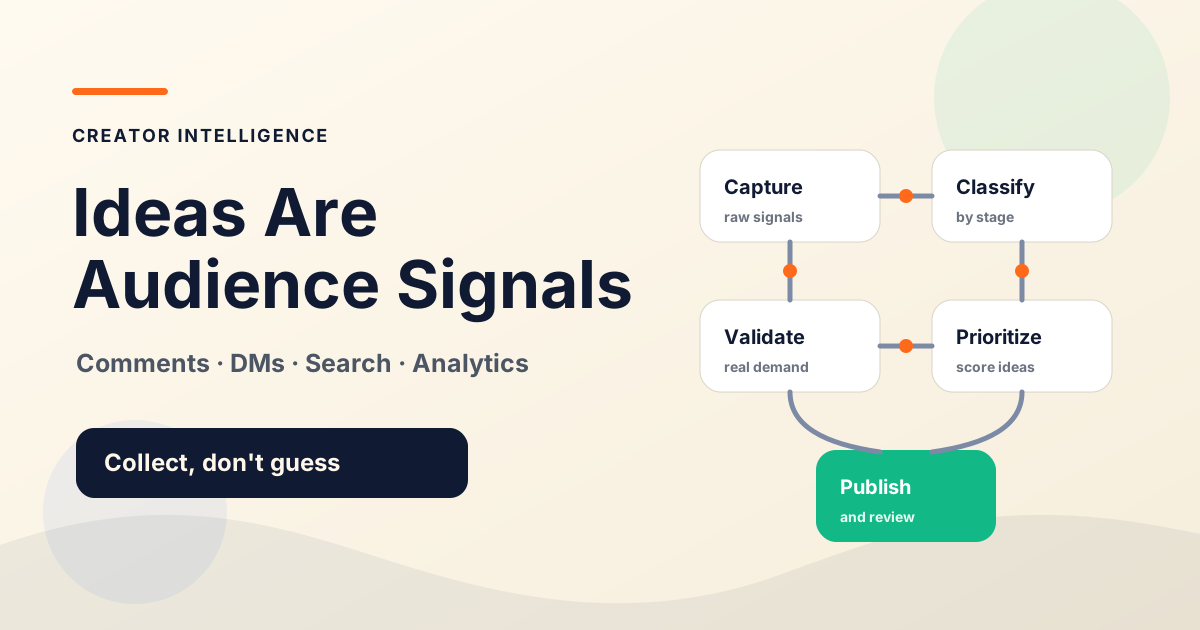
Capturing ideas is step one. Sorting them is what makes them usable.
Classify each idea by where your audience is in their journey. When you tag ideas this way, gaps jump out — maybe you have ten tutorials and zero comparison posts. Now you know what to make next.
Beginner question — “What is X?”
Problem-aware — “Why is X happening to me?”
Solution-aware — “How do I fix X?”
Objection — “Why haven't I done X yet?”
Comparison — “X vs Y — which should I choose?”
Tutorial — “Show me how to do X step by step.”
Story, proof, and offer-related — what happened, does it work, and is your product right for me?
How to Use AI Without Outsourcing Your Judgment
AI is a fantastic research and sorting assistant. It is a terrible replacement for knowing your audience.
AI can help classify a set of comments or research notes that you are permitted to use. Coverage, access rights, freshness, and accuracy vary by tool; do not assume it sees every platform or can predict which topic will become popular.
But here is the trap. If you ask AI for “10 content ideas about my niche,” you will get 10 ideas that sound like everyone else's. Generic in, generic out. Use AI for the heavy lifting, not the thinking.
Summarize and cluster your real comments and questions into themes.
Turn a messy pile of notes into a sorted idea list.
Draft search-intent variations of a question your audience actually asked.
Suggest formats for an idea you already chose.
AI gives you speed. Judgment is still yours — you know which questions your audience keeps asking and which connect to your offer.
A Simple Content Idea Bank Template
You do not need fancy software. A single document or spreadsheet works. For each idea, capture a few fields so it is ready when you plan content.
Raw idea — the question or signal, in plain words.
Source — where it came from (comment, DM, search, analytics, call).
Audience stage — the bucket from above.
Validation notes — is this asked often? Did similar content perform? Does it connect to your business?
Priority score — a quick 1–5 based on audience pain, search demand, your expertise, business relevance, repurposing potential, and timeliness.
Status — captured, briefed, published, or reviewed.
The magic is not the template. It is that you write ideas down the moment you see them, so Sunday night is never blank again.
How to Turn One Idea Into Multiple Formats
Here's where the system pays off. A single validated idea is not one piece of content. It is a cluster.
Take one strong question, then build outward from it. One idea, five formats — that is how creators publish consistently without burning out, and it only works because you validated the idea first.
Write the full post or script that answers it.
Pull the core insight into a short-form video or a quote graphic.
Send it to your email list with a personal angle.
Break the steps into a carousel or thread.
Save the best audience replies as fuel for a follow-up.
Common Mistakes Creators Make
Let me be honest about the traps.
Capturing nothing — ideas you do not write down do not exist by Sunday.
Capturing everything, sorting nothing — a pile of unsorted notes is just noise.
Asking AI to think for you — generic ideas get generic results.
Copying competitors — find gaps, do not duplicate, and never scrape private or paywalled communities.
Ignoring your own analytics — your past content is telling you what to make next.
Skipping the review step — if you never check what worked, you keep guessing forever.