

Introduction
Introduction
Most creator products do not fail at launch — they fail at the idea, and the creator only finds out after weeks of building. The trap is encouragement: you mention an idea, people say they would buy it, and you treat that as a green light.
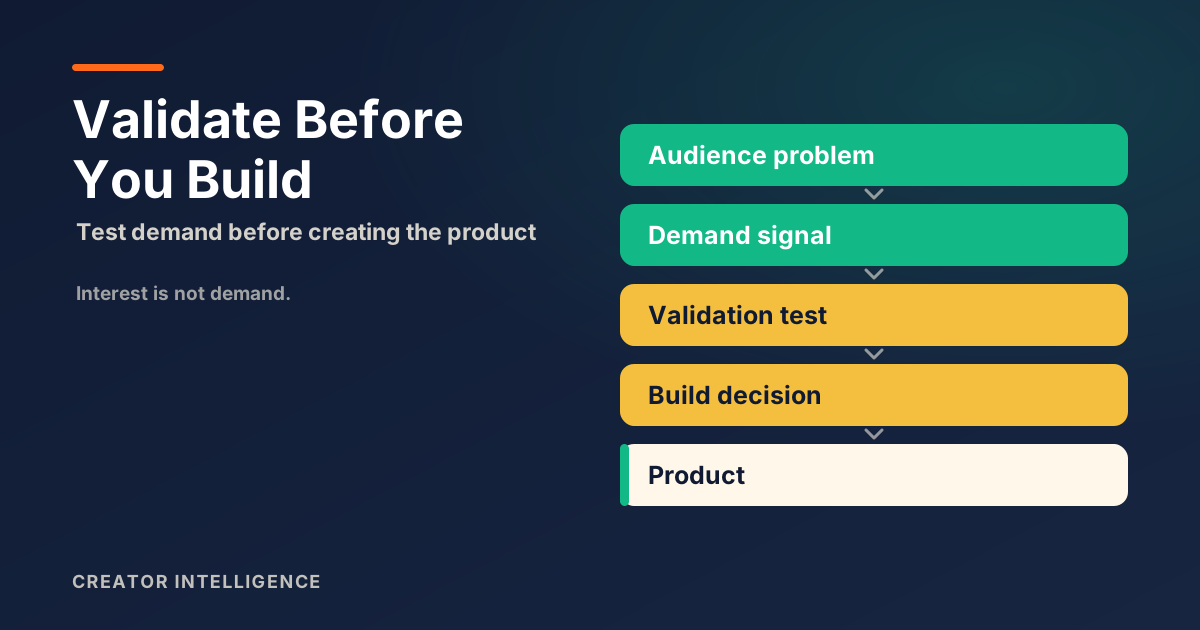
The fix is simple: test for demand before you build, not after. A small action from your audience proves far more than a compliment.
This guide covers the difference between interest and demand, the signals to look for, a menu of validation methods, and a 7-day plan to get a real answer before you commit.
Why Creators Should Validate Before Building
Building is the expensive part. It costs you weeks of time, energy, and the opportunity to work on something that would have sold.
Validation flips the order. Instead of building first and hoping, you spend a few days gathering evidence: does this problem repeat, do people already try to solve it, and will they take a small action toward your solution? If yes, you build with confidence; if no, you have saved a month.
This is the audience-to-offer step done deliberately. You are not guessing what your audience wants — you are letting their behavior tell you before you commit.
The Difference Between Interest and Demand
This is the distinction that saves creators the most wasted work.
Interest is a feeling — 'that sounds useful,' 'cool idea.' It costs nothing to say, so people say it freely, especially to someone they like.
Demand is an action: replying to claim a spot, joining a waitlist, booking a call, or putting money down on a pre-sale. Actions cost something — attention, an email address, money — so they reveal what people actually value. The rule is simple: trust actions, not compliments. Ten people saying they would buy it is interest; three people pre-ordering is demand.
Start With a Repeated Audience Problem
Validation is easiest when the idea grows from a problem you have already seen repeat.
Look for the question you get asked over and over — in comments, DMs, and replies. A problem that shows up weekly, from different people, in similar words, is a product waiting to happen. A problem you think people have, but have never heard them voice, is a guess.
Write the problem down in your audience's own words before you write a single feature. The closer your product promise sounds to how they describe the pain, the easier everything after gets.
Look for Existing Demand Signals
Before you run a single test, you probably already have evidence. Go find it.
Repeated questions in comments, DMs, and email replies.
Saves and shares on content that addresses the problem.
Search behavior — are people actively looking for solutions to this?
Analytics — which topics keep outperforming for you?
Existing alternatives — are people already paying for clumsy or partial solutions?
If several signals point the same way, you are not starting from zero. You are confirming something the audience has already been telling you.
Choose a Simple Validation Method
You do not need all of these. Pick the lightest one that would actually change your decision.
Six validation methods — what each is best for, what it proves, its main risk, and the next step.
| Validation Method | Best For | What It Proves | Main Risk | Next Step |
|---|---|---|---|---|
| Content test | Any idea, earliest stage | Topic pulls attention | Engagement is not purchase intent | Add a CTA to gauge action |
| Survey | Understanding the problem | What people say they want | Stated intent overstates demand | Follow with an action test |
| Waitlist | Mid-stage interest | Enough intent to share an email | Signups are not sales | Invite waitlist to pre-order |
| Pre-sale | Strongest signal | People will pay before it exists | Needs a refund-ready promise | Build for those who paid |
| Discovery call | High-ticket / coaching | Deep problem + willingness to pay | Time-intensive, small sample | Turn insights into the offer |
| Minimum viable product | Validating delivery | People use a small version | Can drift into early building | Ship small, learn, expand |
The hierarchy: content tests and surveys measure interest; waitlists, pre-sales, and discovery calls measure demand. Move toward an action-based test before you commit to building.
What to Measure During Validation
Watch the actions, and listen to the objections.
The actions tell you whether there is demand: replies, signups, calls booked, pre-orders placed. Even small numbers count if they are real. The objections tell you what to fix: when someone says no, or says 'yes, but,' the reason is product research you cannot get any other way — price, format, scope, or timing.
Keep it concrete. 'Five people pre-ordered and three asked for a video version' is a finding. 'People seemed into it' is not.
How to Decide: Build, Adjust, or Stop
Validation is only useful if it leads to a decision.
Build when you see real actions, not just interest — a few pre-orders, a steady waitlist, calls that end in 'when can I get it?'
Adjust when there is clear interest but weak action; the objections point to the fix (format, scope, promise, or price), so re-test the adjusted version.
Stop or shelve when you cannot get past interest — no actions, vague responses, no repeating problem underneath. That is a month saved for a better idea.
Want to sanity-check the upside first? Model conservative, base, and optimistic scenarios in the Creator Revenue Calculator so your build decision rests on numbers, not hope.
A 7-Day Validation Plan
You can get a real signal in a week.
A 7-day plan to validate a digital product idea before building.
| Day | Focus |
|---|---|
| Day 1 | Define the audience problem in their words |
| Day 2 | Collect evidence from comments, DMs, search, and analytics |
| Day 3 | Write a simple product promise |
| Day 4 | Publish a content test on the problem |
| Day 5 | Ask for replies, waitlist signups, or call interest |
| Day 6 | Review the signals and the objections |
| Day 7 | Decide: build, adjust, or pause |
Seven days of evidence beats seven weeks of building on a guess.
Common Mistakes Creators Make
Treating positive comments as proof people will pay.
Building the polished version before testing demand at all.
Relying only on a survey, where stated intent overstates real demand.
Asking leading questions instead of asking for an action.
Ignoring objections instead of mining them for the fix.
Quitting after one weak test instead of adjusting the promise and re-testing.