

Introduction
Introduction
Most creators do not have a business problem — they have a missing-part problem. They post consistently, maybe even grow an audience, and then stall, because content alone is not a system.
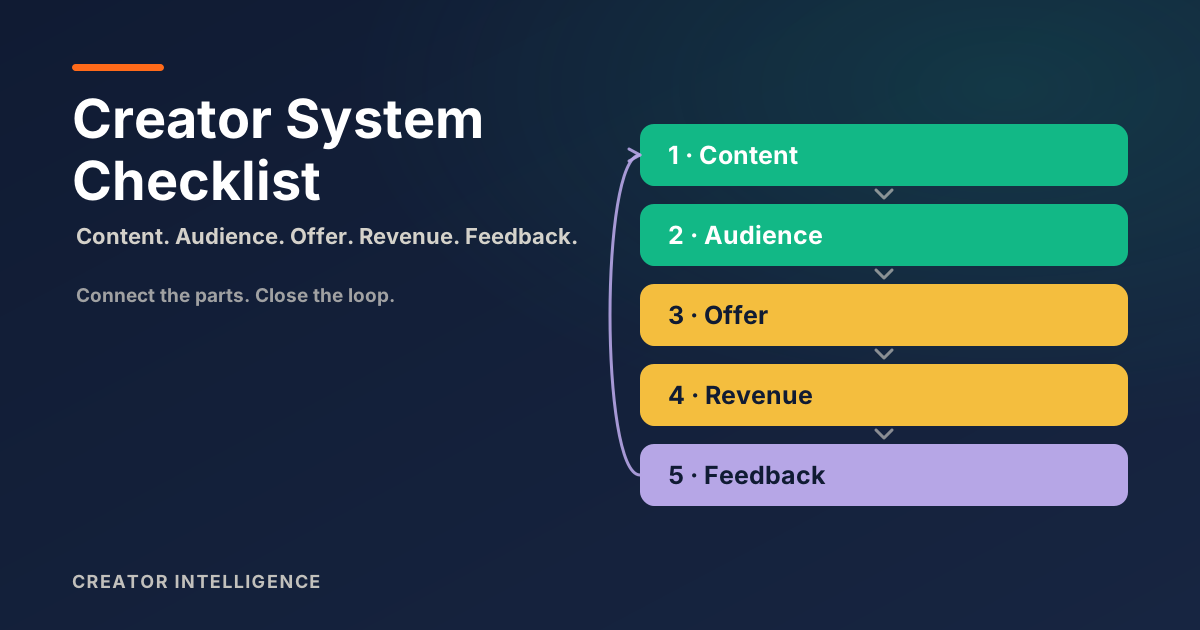
A creator system connects five parts into one loop: content, audience, offer, revenue, and feedback. Miss one and the loop breaks; connect them and the work starts to compound.
This checklist defines each part, gives you a four-point audit for all five, adds a weekly review routine, and names the gaps that most often stall a creator business.
Why Creators Need a System Checklist
Post more is the advice everyone gets, and it is why so many creators are busy but stuck. Volume is not the bottleneck; a missing part of the system is.
A checklist beats motivation here because it is diagnostic. Instead of working harder on the part you already do well (usually content), it points you at the part that is actually holding you back — the offer you never made, the revenue you never modeled, the feedback you never reviewed.
The whole system in one line: Content → Audience → Offer → Revenue → Feedback. Content creates attention and signal; audience reveals trust and repeated problems; the offer is a clear next step; revenue is model validation; feedback is the improvement loop that feeds the next cycle.
Content — Attention and Signal
Content is the top of the system. Its job is not just to be seen — it is to attract the right people and create a next step for them. The trap is making content that earns attention but leads nowhere; every strong piece should connect to an audience problem and point somewhere. Run this content checklist:
Do I know who this content is for?
Does this content connect to a clear audience problem?
Does this content create a next step?
Can this idea be repeated or repurposed?
Audience — Trust and Repeated Problems
Your audience is the signal layer. The comments, DMs, replies, and analytics are constantly telling you what people care about — if you are listening for it. The goal is to know which segment is responding, what they keep struggling with, and to have a way to reach them off-platform. Run this audience checklist:
Do I know which audience segment is responding?
Do I see repeated questions or pain points?
Do I collect audience signals from comments, DMs, analytics, or email replies?
Do I have a way to reach people outside the platform?
Offer — A Clear Next Step
An offer is what turns trust into action. It does not have to be a product — it can be a lead magnet, a call, a waitlist, or a template — but there has to be a next step that solves a real problem, matched to the trust you have earned. Run this offer checklist:
Do I have a clear next step?
Does the offer solve a repeated problem?
Is the offer simple enough to test?
Does the CTA match the trust level of the audience?
Revenue — Model Validation
Revenue is not only about income — it is the test of whether your model actually works. Even small revenue tells you the content, audience, and offer are connected. You do not need a perfect forecast, just the model, the basic numbers, and the one assumption that matters most. Run this revenue checklist:
Do I know the revenue model?
Can I estimate the basic numbers?
Do I know what conversion assumption matters most?
Can I test revenue before scaling?
Feedback — The Improvement Loop
Feedback is the part that turns a one-time effort into a system. Without it, you repeat what you did regardless of whether it worked; with it, every cycle gets a little sharper. Feedback is not vanity metrics — it is a structured review that changes a decision. Run this feedback checklist:
Do I review performance weekly?
Do I track audience questions?
Do I improve prompts, content, offers, or CTAs based on data?
Do I know what to change next?
How to Use the Checklist Weekly
The checklist is not a one-time audit — it is a weekly loop. A 20–30 minute review keeps the system running.
Review your top-performing content.
Identify repeated audience signals (questions, pain points, replies).
Check CTA clicks, email signups, or tool usage.
Compare your revenue or conversion assumptions to what actually happened.
Choose one system improvement for next week.
One improvement per week compounds. You are not overhauling everything — you are closing one gap at a time.
Common System Gaps
Content with no next step — attention that leads nowhere.
No audience capture — everything depends on the algorithm; nothing is owned.
No clear offer — lots of trust, but never an ask.
Unmodeled revenue — selling without knowing which number has to be true.
No feedback loop — repeating effort without reviewing results.
Find your gap, and you have found your highest-leverage next move.